Commedia dell'Arte
This series draws from the tradition of the Commedia dell’Arte, an inventive movement of street actors that travelled from Italy to France and deeply influenced European culture. Celebrated by courts and embraced by writers such as Molière and Marivaux, the Commedia established a repertoire of archetypal figures whose power lay not in fixed identities but in their capacity for transformation. These characters function as masks, or empty shells, capable of absorbing multiple personalities, emotions, and social roles.
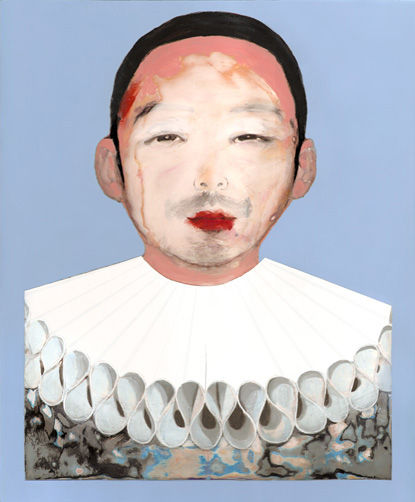
SHUSUKE as Pierrot. Acrylic paint on aluminium. 39,3 x 32,5 cm. 2010-2011

OLYMPIA as Colombine. Acrylic paint on aluminium. 39,3 x 32,5 cm. 2011
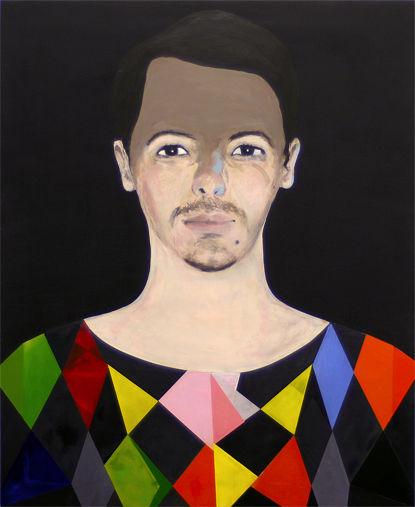
BENOIT as Arlequin. Acrylic paint on aluminium. 39,3 x 32,5 cm. 2012-2013
I began this series while studying at Central Saint Martins, where I met Olympia and Shusuke. I invited them to sit for portraits and asked them, during the sessions, to improvise and embody figures such as Colombine and Pierrot. My intention was to create a convergence between their own personalities and the traits of these historical characters. The resulting images are neither traditional portraits nor theatrical representations, but hybrid constructions where individual presence meets archetype. Each figure becomes a compound, a virtual character formed through the encounter between a real person and a symbolic role. This work is research based and informed by sustained inquiry into the history of Commedia dell’Arte, alchemy, and the notion of virtuality. My interest in alchemy lies not only in its symbolic dimension but also in its material logic of transformation.
In the eighteenth century, Meissen porcelain factories in Saxony produced figurines of Commedia characters during the industrial quest for hard paste porcelain, known as white gold. This pursuit, guided by the alchemist Johann Friedrich Böttger, stands as a historical form of applied alchemy, where material experimentation, secrecy, and transformation converged. These porcelain figures, smooth, luminous, and idealized, resonate strongly with my own approach to surface and materiality.
Colombine, Arlequin, and Pierrot each embody distinct modes of transformation. Colombine is often described as the only true intellect on stage, a catalyst who redirects chaos into strategy. She carries a lunar and white energy, associated with clarity, intelligence, and the albedo phase of alchemy (whitening or purification). Arlequin is a chameleonic figure, oscillating between folly and brilliance, servant and disruptor. His diamond patterned costume evokes transmutation, multiplicity, and the refinement of the base into the brilliant. Pierrot, by contrast, represents an inward and melancholic transformation. His whiteness, silence, and lunar association align with an internal alchemy, where emotional depth and vulnerability become a form of purification. My painting process mirrors these ideas of transformation. I work through successive layers of acrylic paint, sanding and polishing the surface repeatedly until reaching a point of tension and satisfaction. This process produces marble like effects, where traces of previous layers remain visible beneath the surface. The painting accumulates time and gesture, while appearing smooth and resolved. Material presence and erasure coexist, echoing the oscillation between the actual and the virtual. I consider this series part of my broader research into virtuality. The figures I paint are not representations of individuals but virtual images, formed through the superimposition of archetype and lived personality. The characters act as empty shells, capable of incarnation. My friends informed the characters they embodied through their gestures, expressions, and presence, while the historical traits of Colombine, Pierrot, and Arlequin structured the image. What emerges is neither fully fictional nor fully real, but a virtual figure that exists in the space between perception, knowledge, and imagination. Through this work, painting becomes a site of transformation, where material process, historical knowledge, and lived experience converge.
The image operates as a crystal image, in which presence and absence, surface and depth, actual person and virtual character coexist. This series reflects my ongoing interest in how images are formed, inhabited, and transformed, and how painting can function as a space where identity remains fluid, suspended, and open to projection.
Alongside the portraits, the series includes landscapes that function as silent stages. These spaces are devoid of figures yet charged with presence, echoing the theatrical origins of the Commedia. Roads, architecture, and distant light suggest an imminent action or a recently abandoned scene. The landscapes operate as virtual environments, places of projection rather than description, where narrative is suspended. They act at the junction between exterior space and interior state, extending the psychological and symbolic dimensions of the characters into the world around them.

Chevalier. Acrylic paint on aluminium sheet, 60 x 50 cm. 2013

Vitré. Acrylic and oil paint on aluminium sheet, 60 x 50 cm. 2013
JOIN MY NEWSLETTER
Drop your email to stay connected and receive my latest news and updates.